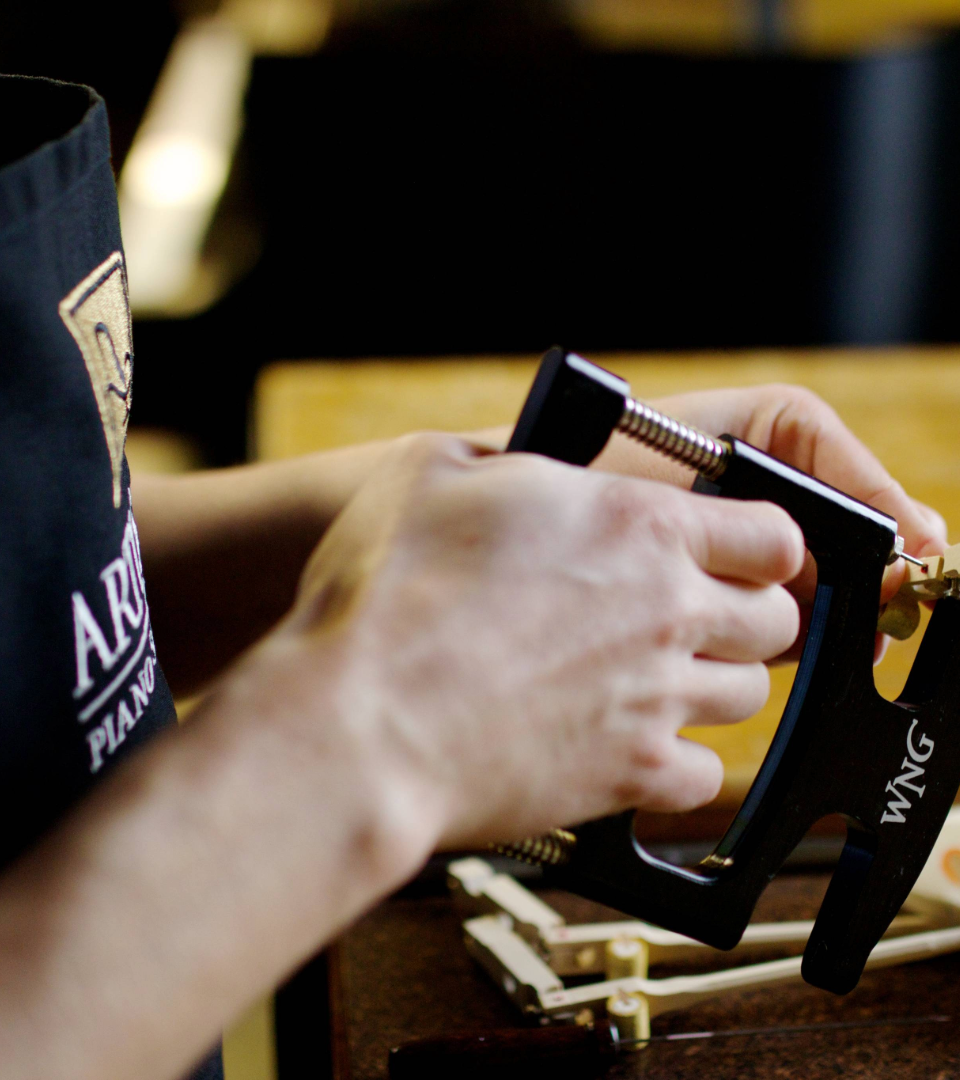
See what happens during a professional piano tuning as we demonstrate the process on both an upright and a grand piano.
Quick Answer
Piano tuning involves carefully adjusting the tension of a piano's strings so each note is at the correct pitch and sounds properly in relation to the rest of the instrument. A technician works through the bass, tenor, and treble sections while using a combination of tuning tools, listening skills, and sometimes an Electronic Tuning Device (ETD). Although upright and grand pianos are built differently, the fundamental principles of tuning apply to both.
Have you ever wondered what actually happens when someone tunes a piano?
In the video below, we're giving you a behind-the-scenes look at how to tune a piano by demonstrating the process on two different instruments. First, you'll see an upright piano being tuned. Then we'll move over to a grand piano so you can see how the process looks on a different style of instrument.
If you're interested in learning piano tuning yourself, this is a great opportunity to watch the process from beginning to end. We'll explain some of what you're seeing, what a technician is listening for, and why the different sections of the piano present different challenges.
What Actually Happens When You Tune a Piano?
From the outside, piano tuning can look deceptively simple.
Place a tuning hammer on a tuning pin, make an adjustment, listen, and move to the next note.
But there's much more happening.
Every adjustment changes the tension of a piano string and therefore its pitch. The technician needs to make extremely controlled movements while listening carefully and making sure the tuning pin is properly set so the note remains stable.
How you physically approach the tuning matters too. Tuning lever control, posture, and learning to feel what the tuning pin is doing all play a role in creating a stable tuning. If you're just getting started, take a look at our Piano Tuning Technique and Posture for Beginners guide for a closer look at developing these foundational skills.
That combination of pitch, listening, tuning pin control, technique, and repetition is what makes piano tuning a skill that takes practice to develop.
If you're interested in turning skills like these into a career, our How to Become a Piano Technician (Complete 2026 Guide) explains the larger path from learning the craft to working professionally.
What Are the Three Main Sections of a Piano Tuning?
As you watch the video, you'll notice the technician gradually working across the piano.
For tuning purposes, it can be helpful to think of the piano in three broad areas:
- Bass
- Tenor
- Treble
Each presents a different tuning challenge.
The Bass Section
The bass is the lowest section of the piano and is often one of the easiest places for a beginning tuner to understand the basic mechanics of tuning.
Some of the lowest notes use a single string, while other bass notes use two strings, called bi-chords.
When two strings produce the same note, the strings need to agree with one another. When they don't, you can hear a pulsing or beating sound between them.
Bringing those strings together into a clean, unified sound is one of the listening skills a tuner develops through practice.
The Tenor Section
As you move into the middle of the piano, things become more complicated.
Many notes now contain three strings, sometimes referred to as trichords.
Those three strings ultimately need to sound like one unified note.
A technician therefore isn't only concerned with whether the overall note is at the correct pitch. The strings within that note also need to agree with one another.
This is where developing a good ear for unisons becomes especially important.
The Treble Section
The treble is generally the most challenging area.
As the strings become shorter, the pitch becomes increasingly sensitive to very small movements of the tuning pin.
A movement that might produce a manageable pitch change elsewhere in the piano can make a much more noticeable difference in the upper register.
The treble can also present additional listening challenges, including false beats, which can make a string sound as though something is out of tune even when the strings of the unison are closely aligned.
This is one reason piano tuning requires much more than simply making every note register correctly on an electronic device.
What Is the Piano Technician Listening For?
This is one of our favorite parts of teaching piano tuning.
When you first watch someone tune, you might wonder:
What are they actually hearing?
A trained technician is listening for relationships between pitches as well as the relationship between multiple strings belonging to the same note.
One of the most obvious examples is a unison.
If two strings that should produce the same pitch are slightly different, you'll hear a pulsating effect called beats. As those strings come into agreement, those beats slow down and eventually the strings begin to sound like one unified pitch.
Once you know what you're listening for, you start hearing things in a piano that you probably never noticed before.
And developing that listening ability takes practice.
What Is Hybrid Piano Tuning?
There are different approaches to tuning a piano.
Traditional aural tuning relies on the technician's ear to establish the temperament and tune the piano through relationships between notes.
An Electronic Tuning Device, or ETD, gives the technician a visual reference for pitch.
At The Artisan School, we also teach a Hybrid Tuning Method, which combines the two.
For example, a technician may use an ETD to establish the pitch of a guide string and then use aural skills to bring the remaining strings of that note into a clean unison.
This allows students to develop both the technical skills of working with an ETD and the listening skills needed to understand what the piano is actually doing.
Want to learn the complete process?
Our Pianocraft: The Complete Piano Technician Training Program teaches both ETD/hybrid tuning and aural tuning through step-by-step lessons, demonstrations, and hands-on assignments.
Is Tuning an Upright Piano Different From Tuning a Grand Piano?
Yes and no.
That's exactly why we wanted to show both in this video.
An upright and grand piano look very different internally. Their strings, actions, cabinets, and physical layouts require the technician to approach the instruments differently.
But the fundamental principles behind the tuning remain the same.
The technician still needs to control the tuning pin, adjust string tension, establish accurate pitch, create clean unisons, and work carefully through the different registers of the instrument.
Watching the process on both types of pianos helps you see that you're not simply memorizing how to tune one particular instrument. You're developing a skill that can be applied across many different pianos.
If you want to take a closer look specifically at the upright process, our How to Tune an Upright Piano training covers the tools, ETD setup, muting, posture, hybrid tuning approach, and tuning stability in much greater detail.
Do You Need an Electronic Tuning Device to Tune a Piano?
Not necessarily.
Pianos can be tuned aurally, electronically, or through a combination of both methods.
In traditional aural tuning, a technician establishes a temperament near the middle of the piano and then works outward through the instrument.
With many ETD-based approaches, the tuner can begin in the bass and work from left to right toward the treble.
Neither approach eliminates the need to understand what you're hearing.
Even when using an ETD, developing your ear is extremely valuable because tuning involves relationships between strings and notes that can't be reduced to simply following a screen.
Why Does Piano Tuning Get Harder in the Treble?
If you watch closely as the tuning progresses toward the upper end of the piano, you'll see that the physical movements become increasingly precise.
That's because the strings become shorter as you move higher.
The shorter string lengths make the pitch highly sensitive to very small tuning pin movements.
The upper register may also contain false beats and other characteristics that make clean unisons more difficult to hear.
This is one of those areas where tuning goes from looking simple to revealing just how much skill is involved.
Knowing what to do is one thing.
Developing the touch and ear to do it consistently is where practice becomes so important.
Can You Learn How to Tune a Piano Yourself?
Yes.
But watching piano tuning videos and actually developing the skill are two different things.
Videos like this one are valuable because they allow you to see the tools, movements, workflow, and differences between instruments.
Then you have to get in front of a piano.
Piano tuning is a physical and aural skill. You develop it through repetition, listening, practicing tuning pin control, learning to hear unisons, and gradually becoming more precise.
Is Piano Tuning Enough to Become a Piano Technician?
Tuning is one of the most important skills a piano technician learns, but it's only part of the profession.
Working technicians may also perform:
- Repairs
- Regulation
- Voicing
- Cleaning
- Piano evaluations
- Pedal and damper service
- Action work
- Preventative maintenance
They also need to learn how to troubleshoot problems, communicate with customers, continue developing their skills, and adapt to the many different pianos they'll encounter in the field.
We've seen some characteristics appear repeatedly in technicians who develop successful careers. You can read more about those in 5 Things Successful Piano Technicians Have in Common!
Key Takeaways
- Piano tuning involves carefully adjusting string tension while controlling the tuning pin and listening to pitch relationships.
- The bass, tenor, and treble sections each present different tuning challenges.
- Notes may contain one, two, or three strings, and multiple strings belonging to the same note must form a clean unison.
- Aural tuning and ETD tuning are different approaches, while hybrid tuning combines elements of both.
- Upright and grand pianos are physically different, but the fundamental principles of tuning apply to both.
- Understanding the process is only the beginning. Becoming a good tuner requires consistent hands-on practice.
Frequently Asked Questions
Can I learn to tune a piano myself?
Yes. Piano tuning can be learned, but it requires more than understanding the theory. Developing accurate tuning pin control, listening skills, and stable unisons requires hands-on practice on real pianos.
Is it harder to tune a grand piano than an upright piano?
The physical layout and access are different, but the fundamental tuning principles are similar. Experience with both instruments helps a technician learn how to adapt those principles to different piano designs.
What does a piano tuner listen for?
A piano tuner listens to pitch as well as relationships between strings and notes. One important skill is hearing beats between strings and adjusting them until a clean, stable unison is produced.
Can you tune a piano with an electronic tuner?
Electronic Tuning Devices are commonly used as part of piano tuning. An ETD can provide a visual pitch reference, while the technician still needs tuning pin control, listening skills, and an understanding of how the piano behaves.
What is hybrid piano tuning?
Hybrid tuning combines an Electronic Tuning Device with aural tuning skills. For example, the ETD may be used to establish a guide pitch while the technician uses their ear to tune other strings into a clean unison.
How long does it take to learn piano tuning?
There is no single timeline. Understanding the process can happen relatively quickly, but developing consistent tuning pin control, listening skills, accuracy, and stability requires repeated practice.
About the Author
David Hayes | Founder and Lead Instructor, The Artisan School
David Hayes has worked as a professional piano technician for more than 20 years and is the founder of Artisan Piano Services and The Artisan School. His experience servicing thousands of pianos in the field helped shape The Artisan School's practical approach to teaching piano tuning, repairs, regulation, voicing, and professional piano service.
Sources and References
Want to Learn How to Tune a Piano Yourself?
Watching a professional piano tuning is a great way to see the process.
Learning why the technician makes each adjustment, what they're listening for, and how to develop those skills yourself is the next step.
Pianocraft: The Complete Piano Technician Training Program teaches piano tuning step by step, including aural tuning and ETD/hybrid tuning, along with repairs, regulation, voicing, and the other core skills used by working piano technicians.
Learn at your own pace, practice on real pianos, and get support while you develop your skills.