Quick Answer
Tight center pins can create excessive friction in a piano action, causing hammers to move sluggishly and potentially making the piano feel heavier or less responsive to the player. A piano technician can evaluate hammer flange movement using a simple swing test and determine whether the pinning is functioning as it should. When center pin friction is excessive, repinning the affected action parts can restore freer, more consistent movement.
Why Can a Piano Action Feel Heavy or Sluggish?
A customer calls you to tune their piano.
You arrive, tune the piano, collect payment and leave. Simple, right? Sometimes.
But one of the biggest lessons we teach at The Artisan School is that a piano is more than its tuning.
When you're in a customer's home, you're there as the piano professional. That means learning to look at the whole instrument and recognize mechanical issues that may be affecting how it sounds, feels and performs.
- A heavy or sluggish piano action is a perfect example.
- The pianist may tell you:
- “My teacher's piano feels so much easier to play.”
- “My keys don't repeat very well.”
- “My piano feels stiff.”
- “I have trouble playing softly.”
Those comments are clues.
There are many things that can affect the touch of a piano, so you never want to jump immediately to one diagnosis. But one of the areas a trained piano technician can evaluate is the center pinning in the action.
That's exactly what happened during the service call that inspired this lesson. When David checked the hammer flanges, they were extremely tight. The customer had already noticed that the piano felt considerably heavier than his teacher's instrument. Pasted text
What Are Center Pins in a Piano Action?
A piano action contains many moving parts that pivot thousands upon thousands of times throughout the life of the instrument.
Center pins create pivot points within many of those action parts.
In a grand piano hammer flange, for example, the center pin passes through the flange bushings and the wooden portion of the flange known as the bird's eye.
That relationship has to be carefully balanced.
Too tight, and the part cannot move freely.
Too loose, and the part may develop excessive movement, instability or noise.
The goal is controlled, consistent movement with the proper amount of friction. This is one reason becoming a piano technician involves much more than learning how to tune strings. A working technician also learns to evaluate repairs, regulation, action problems, voicing and the mechanical systems that affect how the piano performs. Our guide to Piano Tuner vs. Piano Technician: What's the Difference? explores that distinction in much more detail.
How Do You Know if a Piano Has Tight Center Pins?
One of the simplest diagnostic tools is something you already have with you:
Your eyes.
With the grand action removed, a technician can lift a hammer and observe how freely it swings. In the Pacific Northwest, David generally looks for approximately seven swings when evaluating these hammer flanges. In the piano demonstrated during this training, some of the hammers were barely moving at all. Pasted text
That immediately tells us something isn't functioning as freely as expected. The exact evaluation requires experience because hammer weight varies across the action and conditions can differ from piano to piano. The important takeaway for a beginning technician is to start observing movement.
Don't simply look at whether a part moves. Look at how it moves.
- Does it fall freely?
- Does it stop abruptly?
- Does it wobble?
- Does one hammer behave differently from the hammers around it?
Learning to notice those differences is part of learning to diagnose a piano.
What Does a Tight Hammer Flange Feel Like to the Pianist?
This is where piano technology gets interesting because a small mechanical problem can ultimately affect the person sitting at the keyboard. Excessive friction in hammer flange centers can contribute to an action that feels sluggish or stiff and may affect repetition and control.
Imagine throwing a tennis ball toward a gong. Under normal conditions, the ball leaves your hand and continues freely toward the gong. Now imagine trying to make that same throw underwater. You release the ball, but resistance immediately slows its movement. (Mark Cerisano) That's a useful way to think about excessive friction in an action center. The pianist is initiating movement at the key, but the action has to overcome resistance that shouldn't be there.
This doesn't mean tight center pins are the cause of every heavy-feeling piano. They aren't. A technician has to evaluate the complete action before making a recommendation.
What Do Loose Center Pins Look Like?
Center pinning problems can go in the opposite direction too.
A center can become excessively loose.
During the training, David described several clues technicians may notice:
- Excessive side-to-side movement
- Hammers that appear wobbly as they travel
- Audible clicking
- Unusual hammer wear
- Hammer movement that simply doesn't look consistent with the neighboring notes
Hammer wear can be especially revealing. A properly aligned hammer repeatedly contacts the same string area. Excessive side-to-side movement can create a broader or more irregular wear pattern rather than clean, consistent string grooves. Pasted text This is why developing your diagnostic eye matters. Eventually, you'll begin noticing things you probably walked right past when you first started learning piano technology.
What Is Piano Action Repinning?
When excessive center pin friction is diagnosed, a technician may recommend repinning.
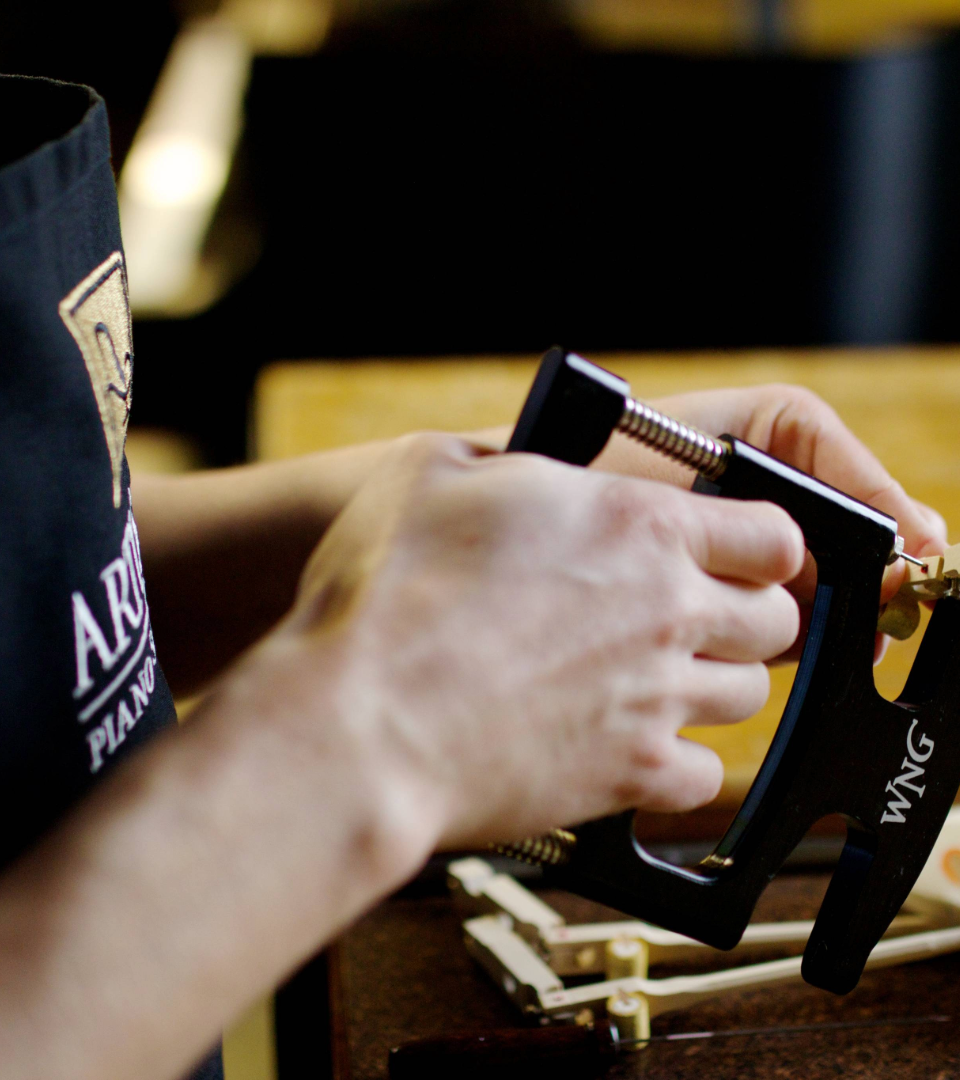
Repinning involves removing the existing center pin, properly fitting the bushing and installing an appropriately sized replacement pin so the action part moves with the correct amount of friction.
Selecting the correct pin isn't simply a matter of grabbing a larger center pin. The replacement pin must fit appropriately in the flange's bird's eye, while the cloth bushing must also be fitted correctly around the pin. During the training, David demonstrates how he evaluates that relationship and describes the properly fitted pin as being gently “hugged” by the felt. Pasted text Pasted text
That feel is difficult to learn from text alone. It's one of the reasons piano technology is such a hands-on craft. You need to understand the concept, watch an experienced technician perform the repair, practice it yourself and gradually develop a feel for what is correct.
That's also the philosophy behind our guide to learning piano tuning online and developing broader technician skills. Online instruction can teach the concepts and demonstrate the work, but hands-on practice is where that information becomes a physical skill.
Why Doesn't the Repair End After the Center Pins Are Replaced?
Here's something beginning technicians can easily overlook.
You repaired the center pinning. You're done!
Not quite.
Removing and reinstalling action parts can affect other adjustments. Hammer travel and spacing need to be checked, and the technician needs to make sure each hammer is properly aligned when the action is returned to the piano. You still need to check hammer travel, correcting it where necessary, and then checking the squaring and spacing of the hammers. Pasted text
The detailed procedures belong in hands-on training, but there's an important lesson here: A piano action is a system. Changing one thing can affect another. Learning repairs isn't just about memorizing how to fix an individual part. It's about understanding how that part interacts with everything around it.
Should Piano Technicians Check the Action During a Tuning?
Yes, and this is one of the habits we encourage our students to develop. You don't need to turn every tuning appointment into a major repair. You also shouldn't look for problems simply because you want additional work.
Instead, evaluate the piano that's actually in front of you.
A customer may have scheduled a tuning because that's the only service they know to ask for. They may have no idea that the sluggish feeling they've noticed for years is something a technician can evaluate. The technician's job is to recognize what's happening, explain it clearly and allow the customer to decide what they'd like to do.
That's part of the difference between thinking like a tuner and thinking like a technician. If you're still developing that broader skill set, start with our guide on how to become a piano technician. It explains why repair, regulation, voicing, diagnosis, structured learning, mentorship and hands-on practice all become part of the craft.
How Do You Explain Tight Center Pins to a Customer?
Keep it simple. You don't need to give the customer a lecture about flange bushings, pin diameters and action geometry.
Show them what you're seeing.
Demonstrate the hammer movement and explain that it isn't moving as freely as it should. More importantly, don't overpromise. Repinning may restore the action part closer to the way it is supposed to function and may give the pianist greater control or a lighter-feeling touch. But every pianist perceives touch differently.
Also be cautions technicians against promising that the piano will suddenly “play like a million bucks.” My recommendation is to explain what is mechanically wrong, what the repair will correct, and what improvement the pianist may experience. Pasted text
That's good piano service. You're not trying to sell the customer something. You're helping them understand their piano.
Why Learning Action Work Matters for Piano Technicians
This repair illustrates something much bigger than center pins. Being a piano technician is different from only knowing how to tune a piano. Tuning is an incredibly important skill, but a service call can reveal so much more.
You may encounter regulation problems, friction, worn parts, broken components, voicing issues, pedal problems, noises or an action that simply hasn't received proper maintenance in years. The more you understand, the more useful you become to the pianist. And that's really what Pianocraft is about.
We want technicians to walk into a customer's home, look at the entire instrument and understand what they're seeing. Not so they can sell unnecessary work. So they can make the piano better.
Key Takeaways
- Center pins create important pivot points within the piano action, and the amount of friction at those centers matters.
- Tight center pins can restrict movement and contribute to sluggish action performance.
- Loose center pins may produce wobbling, clicking, irregular movement or unusual hammer wear.
- A swing test can help an experienced technician evaluate hammer flange movement.
- Repinning requires proper sizing and fitting, not simply replacing one pin with another.
- After repinning, hammer travel, spacing and alignment still need to be evaluated.
- Learning to diagnose action problems is part of becoming a well-rounded piano technician.
Frequently Asked Questions
Can tight center pins make a piano feel heavy?
Excessive friction in action centers can contribute to a piano feeling sluggish, stiff or less responsive. However, many factors can affect piano touch, so the complete action should be evaluated before determining the cause.
How can a piano technician tell if a hammer flange is too tight?
One diagnostic method is observing how freely the hammer swings when lifted and released. The technician considers the number and quality of the swings along with hammer weight, location in the action and the overall condition of the piano.
What is piano action repinning?
Repinning is the process of replacing and properly fitting a center pin in an action part so that the part moves with the appropriate amount of friction.
Can center pins be too loose?
Yes. Excessively loose pinning can create unwanted side-to-side movement, clicking, instability and irregular hammer movement or wear.
Does repinning require additional regulation work?
It can. Anytime action parts are removed and reinstalled, a technician should check travel, spacing, alignment and overall function before considering the repair complete.
How often does a piano need repinning?
There isn't one schedule that applies to every piano. In the live training, David says that in his own field experience he often begins seeing pianos that may need this type of work around the 15-year mark, but he also emphasizes that center pin issues can occur in both newer and older pianos and may be influenced by several factors. Pasted text
About the Author
David Hayes | Piano Technician, Instructor & Co-Founder of The Artisan School
David Hayes has worked as a piano technician for more than 25 years, servicing, repairing and rebuilding pianos while training the next generation of piano technicians. He founded Artisan Piano Services in 2005 and now teaches students around the world through The Artisan School's online courses, live mentoring and hands-on technician training.
Sources and References
This article was developed from a live Artisan School training session on diagnosing and repinning hammer flange center pins.
For broader professional education and industry resources, visit the Piano Technicians Guild.
Want to Learn the Repair Hands-On?
Understanding why a center pin is too tight is the first step.
Learning how to select the proper pin, prepare the bushing, install the new center pin, test friction, travel the hammers and complete the repair correctly takes demonstration and practice.
That's the kind of work we dig into inside Pianocraft and our live mentoring program, where working piano technicians teach the skills we use every day in the field.
Learn the craft. Work on real pianos. Become a piano technician.